When a new food product moves from an idea toward production, teams often need to make important decisions while the product is still only partly defined.
A brief may describe the format, audience and positioning. Packaging artwork may be in progress. Ingredient references may exist in different places. The product itself may still be changing. Yet brand, marketing, design and innovation teams need to agree on what the product should look like before a manufactured sample is available.
Words such as premium, indulgent, fresh or natural can mean different things to different people. Moodboards and flat files help establish a direction, but they do not always give everyone the same picture of the finished product.
This is where 3D CGI becomes more than a way to create a polished image. It becomes a visual tool for evaluating a product concept while the team can still question, refine and align around it.
The gap between a product brief and a product people can evaluate
A written brief can be strategically clear and visually open to interpretation at the same time.
One person may imagine a restrained premium composition. Another may picture a more abundant and expressive product scene. A designer may be thinking about the shape and graphic language, while a marketing team is focused on the promise the consumer should understand first.
These differences are normal, but they can make approval difficult. Teams may spend meetings discussing what a concept could become instead of responding to a visible version of the concept itself.
3D product visualization creates a shared reference. It brings together the product form, visual direction, ingredients, packaging elements and environment in one controllable scene. The image does not need to be final to be useful. It needs to make the important question visible.
That shift changes the conversation from abstract interpretation to specific evaluation.
What food brands can evaluate with 3D CGI
The value of a 3D concept is not limited to showing what a final campaign image might look like. It helps teams examine the decisions that give a product its visual meaning.
The most useful questions are connected to clarity, positioning, relationships between elements and the confidence of the approval process.
Whether the product concept reads clearly
Before refining an image, a team needs to know whether the product is understandable at a glance.
Does the format look like the intended category? Is the main product characteristic visible? Does the composition make clear what is being presented? Does the product feel appropriately sized and structured in relation to the scene around it?
These questions are not limited to aesthetics. They affect recognition and communication. A product can be beautifully presented and still fail to express the idea that the brand needs to convey.
A 3D visualization gives the team a way to assess the concept as a complete visual object rather than as a collection of separate references.
Whether the visual direction supports the intended positioning
The same food product can be communicated in very different ways depending on its visual direction.
Camera height, framing, space, colour relationships, background treatment and the presence of ingredients all influence how the concept is interpreted. A restrained composition may support a premium or sophisticated position. A more generous arrangement may communicate abundance, comfort or indulgence. A clean, open scene may support freshness or simplicity.
3D allows teams to test these directions against the brief before they become difficult to change. The question is not which style looks most impressive in isolation. It is which visual decisions support the product's intended role in the market.
This makes art direction easier to discuss as a business decision, not only as a matter of personal taste.
How the product, packaging and ingredients work together
Food products are rarely communicated as isolated objects. Their visual meaning often depends on the relationship between the product, the package, the ingredients and the surrounding environment.
The product image may need to clarify what is inside the package. Ingredients may explain flavour or quality. Packaging elements may establish brand recognition and information hierarchy. The environment may suggest a moment of consumption or a specific audience.
3D visualization brings these elements into the same scene so the team can evaluate their relationship. Is one element dominating the message? Is the product visible enough? Does the package support the product concept, or do the two seem to belong to different visual worlds?
Packaging is part of this evaluation, but it is not the only focus. The broader question is whether every visible element is helping the product communicate as one coherent idea.
Whether product variations form a coherent family
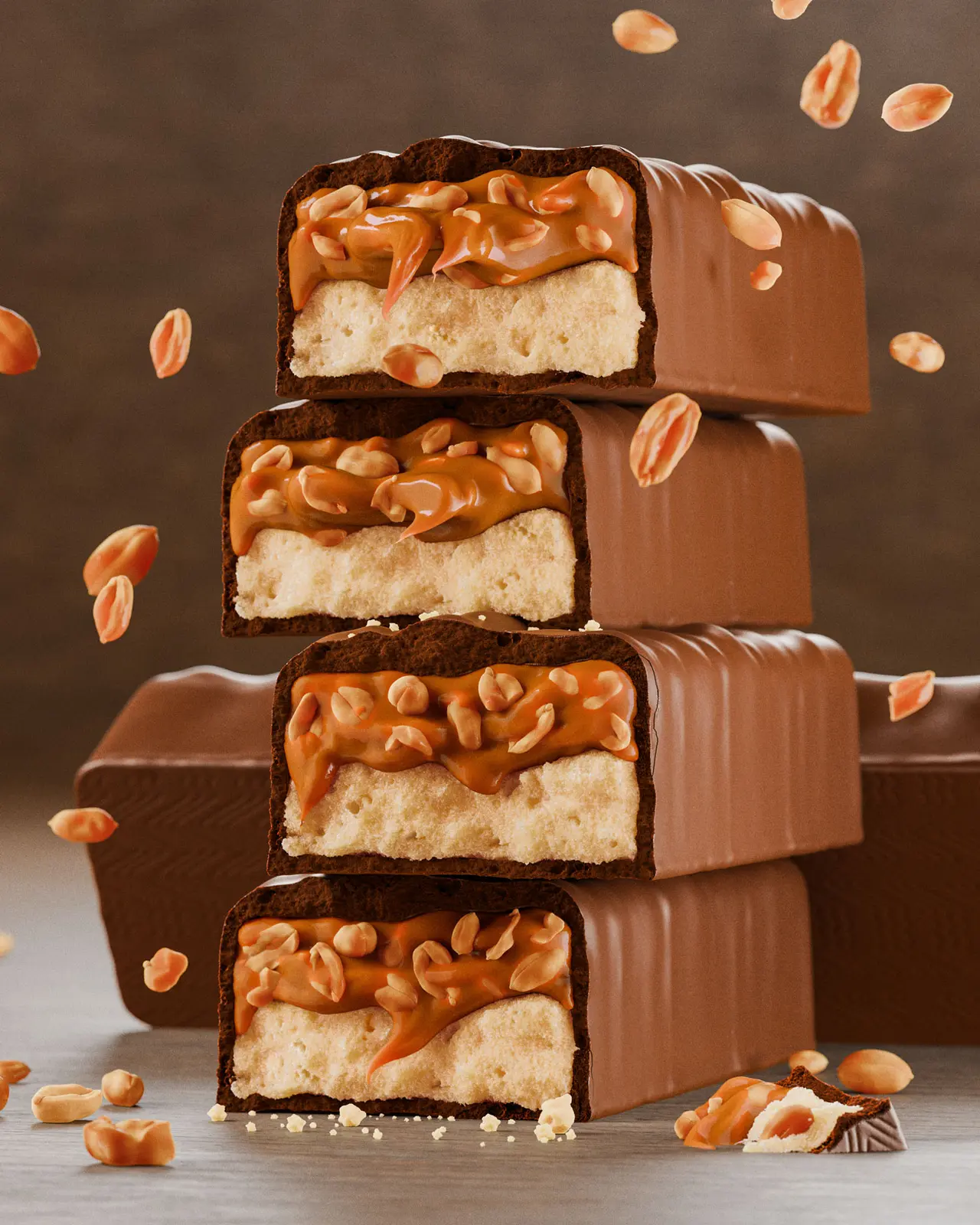
New products often arrive as a range rather than as a single item. Different flavours, sizes, formats or ingredient combinations may need to feel connected without becoming indistinguishable.
A 3D visualization can place these variations in a shared visual context. That makes it easier to evaluate the elements that should remain consistent and the elements that should change.
Teams can ask whether each variation is recognizable, whether the master brand remains clear and whether the range feels intentional. They can also identify visual differences that are too weak to communicate or too strong to preserve family resemblance.
The purpose is not to create every campaign adaptation at this stage. It is to make the product architecture easier to understand before the range moves further into development.
Whether different teams are approving the same idea
Product development involves several kinds of expertise. Brand teams think about positioning. Designers think about expression and hierarchy. Marketing teams think about communication. Innovation teams think about the portfolio. Sales teams may need to present the concept to internal stakeholders or retail partners.
Each group can use a different language to describe what it needs from the product.
A shared 3D visualization gives these groups a common point of reference. Feedback becomes more concrete: the camera feels too distant, the product is not visible enough, the package hierarchy is unclear or the composition does not support the intended audience.
This does not remove disagreement. It makes disagreement more productive because the team is responding to the same visible proposal.
Which questions can be answered visually—and which still require physical validation
One of the most useful roles of 3D is helping teams separate visual questions from technical or physical ones.
A digital visualization can help evaluate composition, proportion, visual hierarchy, product context, material direction and the relationship between different elements. It can support an earlier discussion about what the brand is actually approving.
It does not replace print tests, structural testing, food-styling trials, colour proofs or physical samples. Those stages remain necessary when the decision depends on manufacturing accuracy, tactile behaviour, technical performance or the physical product itself.
By making this distinction clear, teams can use each stage for the question it is best equipped to answer.
Why visual alignment matters before production
The value of early visualization is not simply that it produces an attractive image. It reduces the amount of interpretation required from everyone involved in the approval process.
Without a shared visual reference, feedback can remain broad: make it more premium, show more product, make the flavour clearer, make it feel more natural. These comments may be strategically valid, but they are difficult to translate into precise decisions.
A 3D concept gives the team something specific to examine. It helps separate what is already working from what needs to change and makes the next round of feedback more focused.
That clarity is valuable when the product is still flexible enough to improve. It allows the brand to challenge the concept while the discussion is still about direction—not only about correcting a finished production.
3D visualization is a decision tool, not only a final image
Not every product concept needs a campaign-level render at the beginning.
An early review may require a simple scene that answers a question about shape, proportion or composition. A later approval may need more developed materials, lighting and product detail. A final commercial image may require a fully controlled visual system.
The appropriate level of finish depends on the decision. The goal is not to make every preview look final. The goal is to provide enough visual information for the team to make the next decision with confidence.
This approach also makes the process more honest. A concept image can remain open to discussion instead of creating the impression that every element has already been approved.
What brands need to begin
The starting point does not need to be a perfectly finished production brief.
Useful inputs may include the product brief and intended audience, product dimensions or structural references, packaging artwork or early graphic directions when available, ingredient and texture references, brand guidelines, material references and the specific question the visualization needs to answer.
Is the team evaluating the product concept, the visual positioning, the relationship between product and package, the consistency of a range or the direction of a future campaign? The clearer that question is, the more useful the visualization will be.
3D works best when it is connected to a real decision, not when it is added as decoration after the direction has already been approved.
- Clarify the decision the visualization needs to support
- Gather product dimensions and structural references
- Share available artwork, brand guidelines and material references
- Identify the audience and intended product positioning
- Define what needs visual approval and what still requires physical testing
From an open question to a confident approval
The strongest product visualizations do more than make an idea look finished. They make the idea easier to understand, discuss and improve.
They help teams see whether the product is communicating clearly, whether the visual direction supports its positioning, whether its elements belong to the same product world and whether different stakeholders are evaluating the same concept.
That is the practical role of 3D CGI before production. It gives food and consumer-goods brands a more concrete way to move from a brief to an informed approval while the concept is still flexible enough to evolve.
For a different perspective on the production approach itself, read Product Photography vs CGI: Which Is Better for Food Brands?.
Frequently asked questions
What brands usually ask before starting.
What is food product visualization?
Food product visualization is the creation of a digital representation of a food product, its visual context and, when relevant, its packaging or ingredients. It helps teams evaluate a product concept before the final physical production is available.
What can food brands evaluate with 3D CGI before production?
Brands can evaluate whether the product concept reads clearly, whether the visual direction supports its positioning, how product and packaging elements work together, whether variations form a coherent family and whether teams are responding to the same idea.
Can 3D CGI replace physical samples or technical tests?
No. 3D visualization supports visual decisions, but it does not replace print tests, structural testing, physical samples or other technical validations required for production.
Do brands need final packaging artwork to begin?
Not always. A project can begin with a brief, product references, structural information and an early visual direction. Final artwork and dielines become important when the team needs to evaluate specific packaging communication or production details.
How detailed does the first visualization need to be?
It needs to be detailed enough to answer the decision at hand. An early concept review may require less detail than a final campaign image. The level of finish should follow the question, not the other way around.
Planning a new product?
Turn the brief into something everyone can see.
GS Creative 3D helps food and consumer brands evaluate product concepts through clear, commercially directed CGI before the physical production is complete.
Discuss a project