
When a food brand asks for a product image to look realistic, the request is rarely as simple as it sounds.
The image needs to feel credible enough for people to believe in the product. At the same time, it needs to be appetizing, refined and visually intentional. A chocolate bar may need to look unmistakably real, but also more inviting than an ordinary snapshot. A filling may need to appear soft and rich without becoming artificial. A surface may need to show its texture without distracting from the brand.
That balance is where photorealistic food CGI becomes valuable. For food brands, photorealism is not just a technical achievement. It is a way to shape perception: creating a visual experience that feels believable, desirable and aligned with the product's positioning.
Photorealism is a brand decision, not only a rendering goal
A technically realistic image can still be wrong for a brand.
It may show the product accurately but fail to communicate indulgence, freshness, softness or premium quality. It may contain convincing materials but use a composition that feels flat. It may be detailed and polished, yet leave the viewer with no clear sense of what makes the product worth wanting.
This is why realism should be treated as part of the creative direction, not as the final step after the design is complete.
Before deciding how realistic a product should look, a brand needs to understand what the image is supposed to communicate. Is the product playful or sophisticated? Comforting or energetic? Handmade or highly refined? Familiar or innovative?
The same level of physical accuracy can produce very different perceptions depending on the light, camera angle, colour, surface treatment and amount of visible imperfection.
Photorealistic CGI gives the creative team control over those decisions. It allows the product to remain recognizable while the visual language is shaped around the brand's promise.
The most convincing food visuals live between reality and idealization
The best food imagery usually sits between two extremes.
On one side, there is physical reality: the uneven surface, the natural variation, the way light behaves on a material and the small imperfections that make an object believable.
On the other side, there is creative idealization: the carefully chosen colour, the controlled highlight, the perfectly timed break, the generous filling and the composition designed to create appetite.
An image that is too perfect can feel synthetic. An image that is too ordinary may fail to express the product's full potential.
The challenge is to make the product feel real, but not limited by the conditions of a single physical photograph.
That may mean emphasizing the softness of a filling, refining the shape of a chocolate coating or controlling the amount of shine on a surface. It may mean showing a product at the exact angle where its layers, texture and proportions are easiest to understand.
This is not about deceiving the viewer. It is about communicating the intended product experience with clarity and impact.
What makes a food image feel real to the viewer?
Photorealism is perceived through a combination of signals. Viewers do not consciously analyze every detail, but they respond immediately when those signals feel consistent.
Material behavior
Different foods respond to light in different ways.
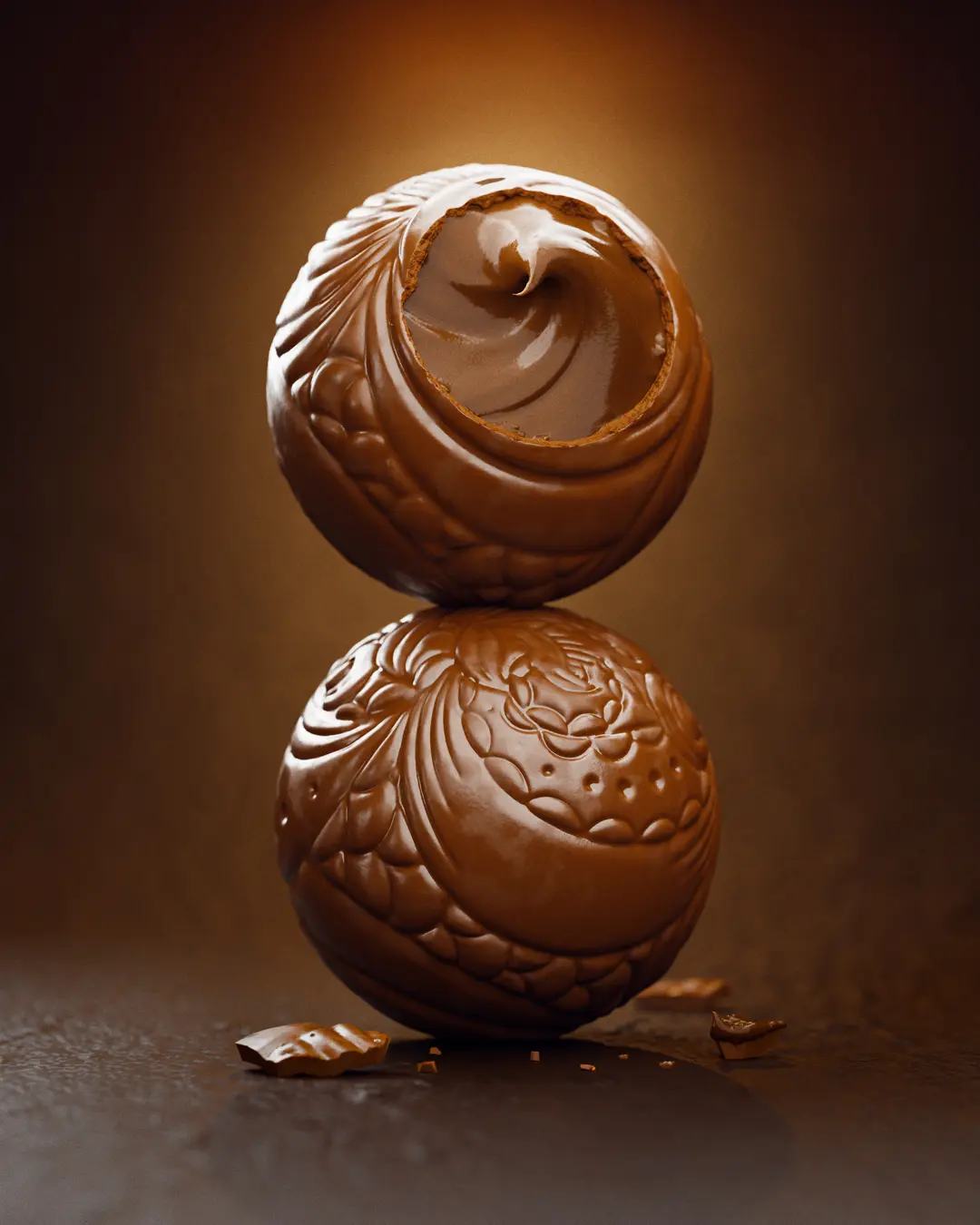
Chocolate can appear smooth, dense and slightly reflective. A baked cookie may need a drier, more irregular surface. A fruit filling may require softness, moisture and controlled translucency. A marshmallow may need to feel light, elastic and delicate rather than plastic.
When the material behavior matches the viewer's expectations, the product becomes easier to believe.
The important point is that realism does not come from adding detail everywhere. It comes from making the right details behave correctly.

Texture at the right scale
Texture helps the viewer understand what a product might feel like to touch or eat.
But texture can also become visual noise. Excessive pores, bumps or surface variation may make a product look dirty, damaged or less appetizing. A strong food visual uses texture selectively, placing detail where it reinforces the product's character.
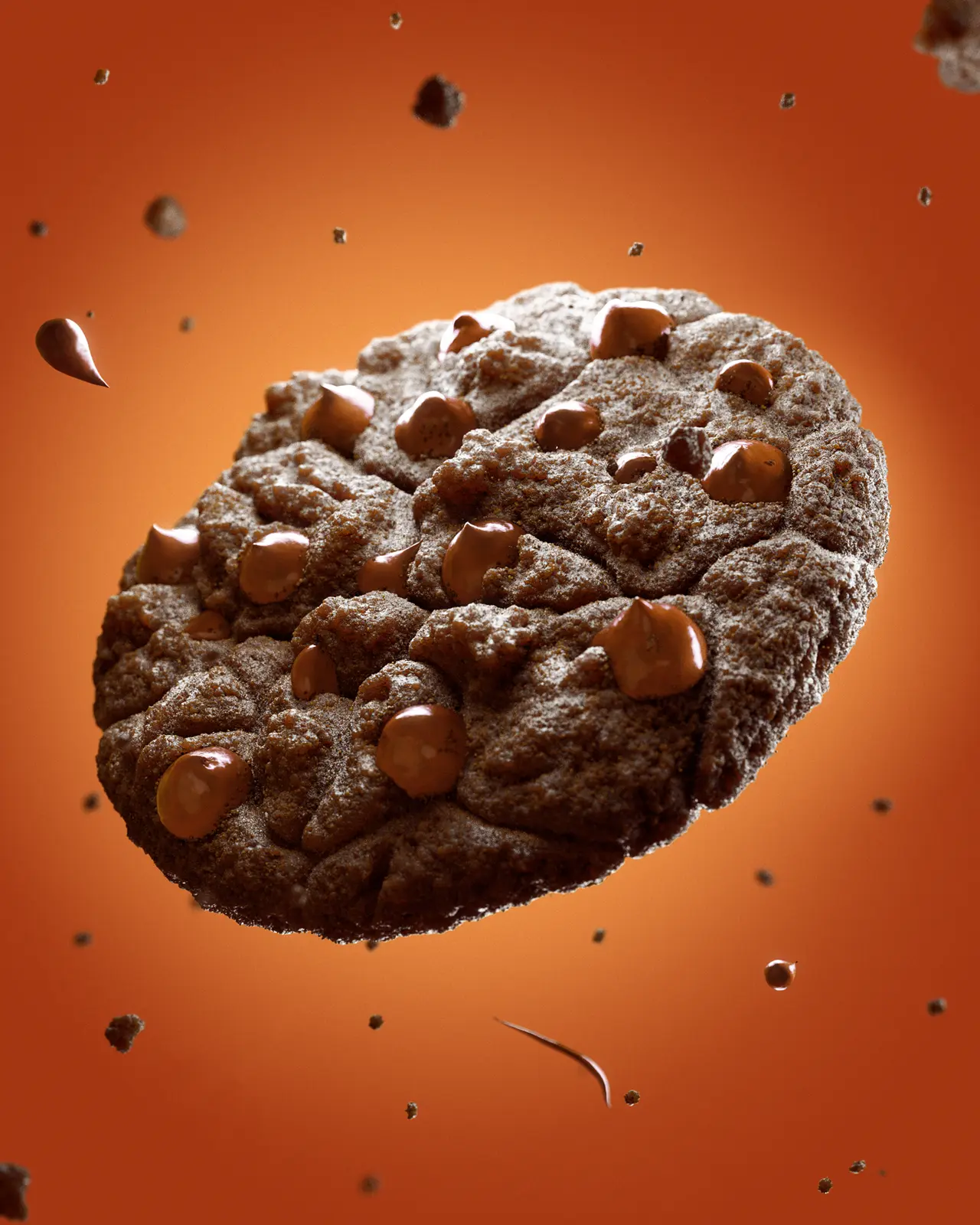
For a cookie, that might be the baked edge, the irregular crumb and the way chocolate chips sit within the surface. For a truffle, it might be the contrast between the shell and the softer interior. For a filled bar, it may be the relationship between the coating, the filling and the point where they meet.
The viewer should feel the material without having to study it.

Light that reveals volume
Lighting does more than make a product visible. It explains its volume, density and surface quality.
Soft light can make a product feel generous and premium. More directional light can reveal a crisp edge, a break or a layered structure. Controlled highlights can suggest gloss, moisture or a smooth coating, while deeper shadows can give the product weight and contrast.
The most effective lighting choices are connected to the brand's desired perception. A dramatic, high-contrast setup may support a rich, indulgent product. A brighter and softer setup may communicate freshness, lightness or approachability.
Imperfection and variation
Perfect symmetry is not always convincing in food imagery.
Small variations in shape, thickness, crumbs, edges and surface finish can make a product feel more tangible. They suggest that the object exists in the physical world rather than being generated from a perfectly uniform template.
However, imperfection must be intentional. Random damage or excessive irregularity can weaken the product's appeal. The goal is not to make the product look careless. It is to give it enough variation to feel authentic while preserving the visual control expected from a brand image.
Composition and appetite appeal
Even a beautifully modelled product can lose impact if it is shown without a clear visual hierarchy.
Scale, spacing, camera position and cropping all influence what the viewer notices first. A close-up can make a texture feel tangible. A wider composition can establish a premium atmosphere. A carefully placed break can reveal the interior and give the viewer a reason to look closer.
Composition turns realism into communication. It guides attention toward the detail that best expresses the product's promise.

Why this balance matters to food brands
For a brand team, the value of a photorealistic visual is not limited to making a product look attractive.
The image may be used to align internal teams around a new concept, communicate a product direction to partners, present a campaign idea or build a visual world before every physical element is available.
It can also help a brand establish a consistent visual standard across products, flavours and formats. When the product is treated with the same level of care from one image to the next, the brand feels more intentional and recognizable.
This is especially important when the image needs to work across multiple contexts. A hero visual for a campaign may need to create immediate desire. A packaging visual may need to explain the product clearly. An e-commerce image may need to remain legible at a smaller scale.
The visual language can change between applications, but the product should still feel like the same product.
Photorealistic CGI does not mean photographic imitation
Photorealistic CGI is sometimes understood as an attempt to replace photography by copying it as closely as possible.
That is too limited a view.
CGI can create a controlled product image when the physical product is still evolving, when a specific setup would be difficult to photograph or when the brand needs to explore several visual directions efficiently. It can also make it easier to maintain a consistent product across different angles, compositions and campaign applications.
The objective is not to make the viewer ask whether the image was photographed or rendered. The objective is to make the product feel present, convincing and desirable.
When the CGI disappears, the product and the brand are allowed to take the lead.
For a practical look at when CGI creates more value than a single photographic production, read Product Photography vs CGI: Which Is Better for Food Brands?.
The right question is not only ‘Does it look real?’
A better evaluation asks several questions at once:
- Does the image make the product easy to believe?
- Does it communicate the texture and quality people should expect?
- Does it create appetite and desire?
- Does it reflect the brand's visual personality?
- Does it remain convincing across different products and applications?
- Does the image show the product in the most meaningful way?
From realistic detail to product desire
The strongest food CGI does not call attention to the complexity of the 3D process behind it. It makes the product feel immediate.
You can almost understand the texture of the surface, the density of the coating or the softness of the filling before tasting it. The image gives the product a presence that is credible enough to trust and refined enough to desire.
That is the balance brands are often looking for: not reality for its own sake, and not idealization without credibility, but a visual interpretation that makes the product feel real and worth choosing.
Photorealistic food CGI is most effective when it supports that larger goal. It turns material, light and composition into a clear expression of the product promise—helping brands show not only what a product looks like, but how it should be perceived.
If your next food or consumer product needs to look real, desirable and aligned with your brand, discuss the project with GS Creative 3D.
Frequently asked questions
What brands usually ask before starting.
What is photorealistic food CGI?
Photorealistic food CGI is a digitally created product image designed to feel physically believable. It combines accurate materials, lighting, texture, scale and composition with creative direction that supports the brand's intended perception.
How do brands balance realism and idealization?
Brands use realism to establish credibility and idealization to make the product more appealing, clear and aligned with the campaign. The balance depends on the product, audience and desired positioning.
When should a food brand use CGI instead of photography?
CGI is especially useful when a product or package is still evolving, when multiple variations are needed, or when the brand requires precise control over angles, materials, lighting and campaign compositions.
Can photorealistic CGI be used across different marketing channels?
Yes. A well-planned CGI asset can support campaign visuals, packaging presentations, e-commerce imagery, social content and other formats while maintaining visual consistency.
Planning a campaign?
Make the product feel real—and worth wanting.
GS Creative 3D creates photorealistic CGI assets for food and consumer brands, designed for packaging, product launches, advertising and digital campaigns.
Discuss a project